Victoria’s Midday Power Saver: What Three Free Hours Mean for a Home Battery
From 1 October 2026 Victorian households can get free electricity from 11am to 2pm, up to 24 kWh a day, with slightly higher prices at other times. Here is what the published tariffs mean for a home battery, zone by zone.
From 1 October 2026, Victorian households can opt into the Midday Power Saver. Electricity is free between 11am and 2pm every day, up to 24 kWh a day, and every other hour is priced a little higher than the default time-of-use offer.
For a home with a battery, that changes one number in the business case. Grid power at midday used to cost 16.6 to 17.7 cents per kWh on the default time-of-use tariff. On the Midday Power Saver it costs nothing, so a kWh stored at lunchtime and used at 6pm is worth the full evening peak rate: between 39.75 and 49.82 cents, depending on where you live.
This guide works through the published tariffs zone by zone, what the free window costs you at other times of day, and what it means for sizing, charging and wiring a battery. Every tariff figure below comes from the Victorian Government and the Essential Services Commission.
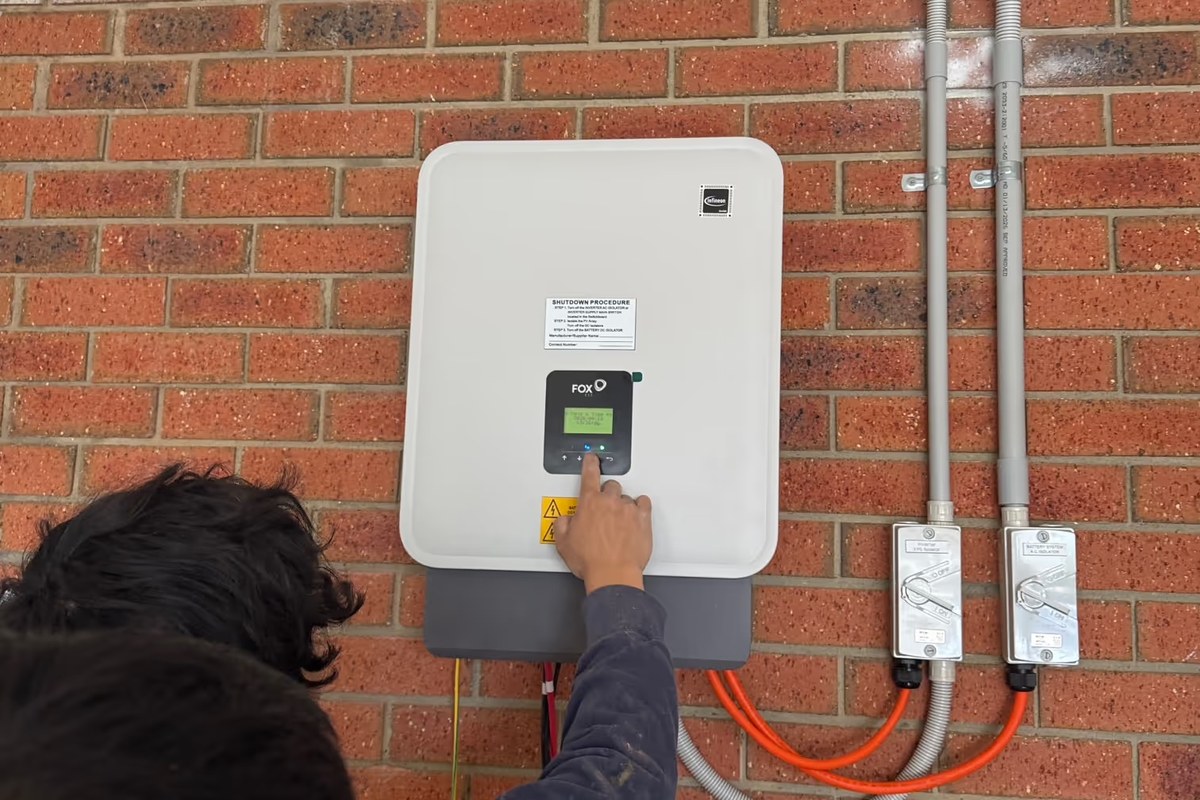
Commissioning a Fox ESS inverter on a Melbourne job. When a battery charges, and from where, is part of the system configuration, so it can be revisited when your tariff changes.
What the Midday Power Saver is
The Midday Power Saver is a voluntary electricity tariff set by the Victorian Government and regulated by the Essential Services Commission. The key settings, from the Victorian Government’s energy website:
Start date: available to eligible households from 1 October 2026. You sign up through your electricity retailer.
Free window: 11am to 2pm, every day of the week, in all five distribution zones.
Fair use cap: up to 24 kWh of free electricity per day during the window. Use above the cap can be charged.
Who offers it: most retailers are required to make it available.
Protections: a cooling-off period after signing up, and you can leave it at any time with no exit fees.
Review: the Essential Services Commission reviews it annually. The Order in Council that sets it up was gazetted on 8 September 2026.
The government estimates households that sign up could save between $149 and $428 a year, assuming they shift 5% to 30% of their use into the window. Households with an electric vehicle that charge in the window could save up to $1,102 in total. When the scheme was announced in March 2026, the Premier’s office put the figure for households with solar panels and batteries at up to $1,070 a year. Those are government estimates. Your own result depends on how much use you can move.
The published tariffs, zone by zone
These are the maximum charges under the Midday Power Saver standing offer for domestic customers without controlled load, from 1 October 2026 to 30 June 2027, including GST.
Distribution zone
Supply ($/day)
Off peak 9pm to 11am
Free window 11am to 2pm
Solar soak 2pm to 4pm
Peak 4pm to 9pm
AusNet
$1.2824
$0.2478
$0.00
$0.1976
$0.4982
CitiPower
$1.2114
$0.2322
$0.00
$0.1864
$0.4036
Jemena
$1.2712
$0.2394
$0.00
$0.1983
$0.3975
Powercor
$1.3805
$0.2462
$0.00
$0.1939
$0.4381
United Energy
$1.1912
$0.2427
$0.00
$0.1939
$0.4245
Your distribution zone is printed on your electricity bill. It is set by the poles and wires in your street and stays the same when you change retailer. We covered how to find it, and what the zones mean for solar exports, in our guide to Victorian feed-in tariffs.
What the free window costs you at other times
The free hours are paid for by slightly higher prices in the other 21. The Essential Services Commission based the tariffs on the 2026-27 Victorian Default Offer, with a relative increase outside the free period.
We lined the two tables up. Against the Victorian Default Offer three-period time-of-use tariff that has applied since 1 July 2026, the supply charge is unchanged in every zone, and every priced kWh on the Midday Power Saver costs between 2.05 and 2.18 cents more:
Zone
Default offer peak
Midday Power Saver peak
Extra per priced kWh
AusNet
$0.4764
$0.4982
2.18c
CitiPower
$0.3831
$0.4036
2.05c
Jemena
$0.3757
$0.3975
2.18c
Powercor
$0.4167
$0.4381
2.13c to 2.14c
United Energy
$0.4032
$0.4245
2.13c
The same gap applies to the off-peak and 2pm to 4pm bands. That gives a quick test for any household, with or without a battery.
The 11 per cent test
On the default time-of-use tariff, a kWh used between 11am and 2pm costs the solar soak rate, around 17 cents. On the Midday Power Saver it costs nothing, but every kWh outside the window costs about 2.1 cents more. Set one against the other and the break-even point comes out almost identical in all five zones: about 11% of your grid use needs to land in the free window before the Midday Power Saver beats the default time-of-use offer.
Below that, you pay more. That matches the warning the government has written into the scheme: retailers must tell you it is best suited to customers who can shift their electricity use, and that costs could be higher if you cannot.
Two caveats. This compares against the regulated default offer, and many households are on market offers priced below it. And some retailers already sell their own plans with free midday hours. Victorian Energy Compare, the government’s free comparison site, will show the Midday Power Saver next to the offers available at your address.
What it changes for a home battery
A battery earns money by moving a kWh from a cheap hour to an expensive one. The Midday Power Saver makes the cheap hour free, which widens the gap for any kWh the battery takes from the grid at lunchtime.
Zone
Grid-charged kWh used at peak, default offer (peak minus solar soak)
Same kWh on the Midday Power Saver
Grid-charged kWh used overnight, Midday Power Saver
AusNet
30.05c
49.82c
24.78c
CitiPower
21.72c
40.36c
23.22c
Jemena
19.92c
39.75c
23.94c
Powercor
24.41c
43.81c
24.62c
United Energy
23.06c
42.45c
24.27c
Figures are before the energy a battery loses when it charges and discharges, which varies by product and is listed on its datasheet.
Read across a row and two things stand out. A kWh bought from the grid at midday and used during the 4pm to 9pm peak is worth roughly 1.7 to 2 times what it was on the default time-of-use tariff. And the last column is new. Under the default offer, charging from the grid at midday to cover overnight use saved only about 4 to 5 cents per kWh, which rarely justified the extra capacity. On the Midday Power Saver the same kWh avoids the full off-peak rate of 23 to 25 cents.
As an indicative scenario only: in the United Energy zone, a household that fills 10 kWh of battery in the free window and uses all of it between 4pm and 9pm avoids about $4.25 of peak charges that day, before battery losses, against about $2.31 for the same pattern on the default time-of-use tariff. The figures come straight from the published tariffs and are not a savings estimate for your home.
Three hours turns charge power into a sizing question
Until now, battery sizing in Victoria has mostly been about capacity: how many kWh the house uses between 4pm and 9pm. We still size from that number, and we explain the method in what size home battery you need.
A fixed three-hour window adds a second number: how fast the battery can charge. The ceiling is charge power multiplied by three hours. A system that charges at 5 kW can take in at most 15 kWh during the window. At 8 kW, up to 24 kWh. Capacity beyond what the system can fill in three hours still has to come from your roof, or from paid hours.
This is the reason to ask for the continuous charge rating of the battery and inverter combination in any quote, alongside the usable capacity.
The 24 kWh cap is shared by the whole house
The daily cap covers everything drawn from the grid between 11am and 2pm. Battery charging, the dishwasher, the hot water system and the car all count towards the same 24 kWh.
An electric vehicle on a 7 kW wall charger for the full window draws 21 kWh by itself. Add a battery charging at 5 kW and the house is well past the cap before anything else runs. If you have both, the charge schedules need to be planned together. We went through the EV side of this in charging an EV from a home battery.
If you already have solar
For a house with panels on the roof, midday electricity was already close to free whenever the sun was out. The Midday Power Saver matters on the days when the roof falls short: cloudy days, short winter days, or a large battery on a small array. On those days, the battery can top up from the grid in the window at no cost instead of starting the evening half full.
The trade-off is the 2.1 cents or so on every other kWh you buy. If your solar and battery already cover most of your evening, the extra on your remaining grid use can outweigh what the window saves. Run the 11 per cent test against your own bill.
One thing the published tariffs do not cover is what you are paid for exports. Victoria has had no regulated minimum feed-in tariff since 1 July 2025, so the export rate on any plan is set by the retailer. Ask what it is before you switch.
If you are looking at adding storage to an existing system, our retrofit guide covers the inverter and switchboard checks that come first.
If you do not have solar yet
Free midday power makes a battery-only setup, charged entirely from the grid, look tempting. Check the federal discount before you plan around it. The Department of Climate Change, Energy, the Environment and Water states the Cheaper Home Batteries discount is available for batteries connected to new or existing solar PV systems.
Under the current settings, that discount is worth up to $272 per kWh on the first 14 kWh of usable capacity, at the regulated $40 Clearing House certificate price, for batteries installed by 31 December 2026, and it is set by the installation date. The STC Factor drops from 6.8 to 5.7 on 1 January 2027. We break down the full calculation in the Victorian battery rebate guide.
The switchboard question
The Victorian Government’s own guidance on the Midday Power Saver includes an electrical safety note. If you plan to run several high-energy appliances in the free window, including batteries and EV chargers, spread their use across the three hours instead of running them at the same time. That reduces the chance of tripped circuit breakers and blown fuses. If your home has older wiring or an older switchboard, the guidance is to speak with a licensed electrician first.
The practical point is that kW add up, even when kWh stay under the cap. A battery charging, an EV charger and a heat pump hot water system starting together at 11am can ask more of an older board and supply than it was built for.
We check the switchboard and the supply at every assessment, and set the charge schedule at commissioning around the tariff you are on. The steps are in what happens on installation day.
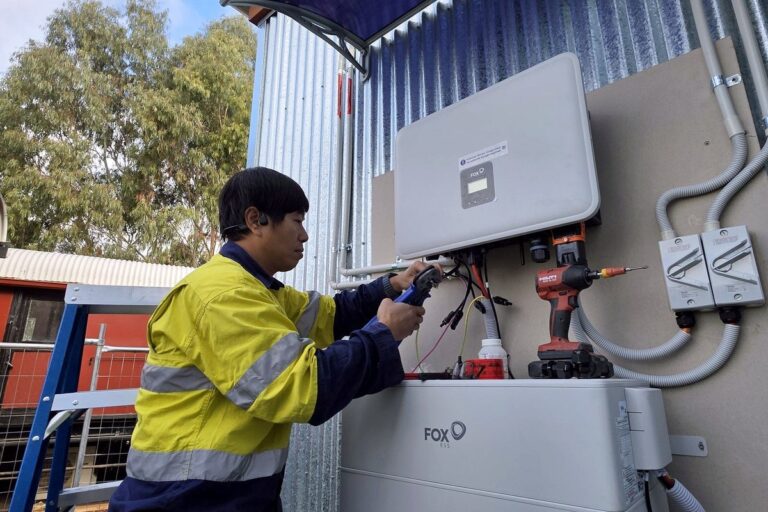
A Fox ESS inverter and battery stack we commissioned at the Mansfield Heritage Museum. Its charge power decides how much of a three-hour window the system can use.
Should you switch on 1 October?
Three numbers from your bill answer most of it.
Your distribution zone. It sets every rate in the tables above.
How much of your grid use could sit between 11am and 2pm. If it is under about 11%, the default time-of-use offer, or a market offer, is likely to be cheaper.
How much you use between 4pm and 9pm. That is what a battery would cover, and it is the number we size from.
If you have a battery, or are about to install one, add a fourth: the charge rate. It decides how much of the free window your system can use.
The plan and the battery are best decided together. A battery configured for the default time-of-use tariff may need its schedule changed to get the most from the free window, and a plan chosen without the battery in mind can leave money on the table.
Frequently asked questions
When does the Midday Power Saver start?
It is available to eligible Victorian households from 1 October 2026. You sign up by contacting your electricity retailer from that date. Source: Victorian Government, energy.vic.gov.au.
What hours are free on the Midday Power Saver?
11am to 2pm every day, in all five Victorian distribution zones, up to 24 kWh per day. Use above the fair use cap can be charged. Source: Victorian Government, energy.vic.gov.au.
Can I charge my home battery for free during the window?
The Victorian Government lists batteries among the appliances to run in the free period, and advises spreading battery and EV charging across the three hours. Whether your battery draws from the grid at that time depends on how the system is configured. Battery charging counts towards the 24 kWh daily cap along with everything else in the house.
Is the Midday Power Saver cheaper than the Victorian Default Offer?
Only if you shift enough use into the window. Outside 11am to 2pm, every priced kWh costs 2.05 to 2.18 cents more than the Victorian Default Offer time-of-use tariff, depending on zone. By our calculation from the published tariffs, about 11% of your grid use needs to fall in the free window to break even against that default offer.
Does the Midday Power Saver change the federal battery discount?
No. The Cheaper Home Batteries discount is a separate federal program. It is available for batteries connected to new or existing solar PV, and the amount is set by the STC Factor on the date the battery is installed: 6.8 until 31 December 2026, then 5.7 from 1 January 2027. Source: DCCEEW.
Can I leave the Midday Power Saver if it does not suit me?
Yes. There is a cooling-off period after signing up, and you can switch off the Midday Power Saver at any time with no exit fees. Source: Victorian Government, energy.vic.gov.au.
Want your numbers run
Send us a recent bill that shows your distribution zone and your time-of-use breakdown. We will tell you roughly what share of your use could move into the free window, how much of your evening a battery would cover, and what charge rate you would need to use the window properly. If you already have a battery, we can check whether its current schedule suits the new tariff.
Victorian Government, Victorian Midday Power Saver, energy.vic.gov.au, page updated 23 September 2026. Start date, free window, 24 kWh fair use cap, tariffs for 1 October 2026 to 30 June 2027, household savings estimates, consumer protections, electrical safety guidance, Order in Council gazetted 8 September 2026.
Essential Services Commission, Victorian Default Offer, 2026-27 three-period time-of-use tariffs for domestic customers, applying from 1 July 2026.
Department of Climate Change, Energy, the Environment and Water, Cheaper Home Batteries Program, page updated 9 June 2026. Eligibility, STC Factor schedule and installation date rule.
All government pages checked on 24 September 2026. Comparisons with the Victorian Default Offer and the per-kWh values are E3 Energy calculations from the published tariffs. They are indicative, exclude battery losses and are not a savings estimate for any particular home. Tariffs are reviewed annually and can change.