A Real Melbourne Bill After Solar and a Battery: $3.37 a Day to $1.17
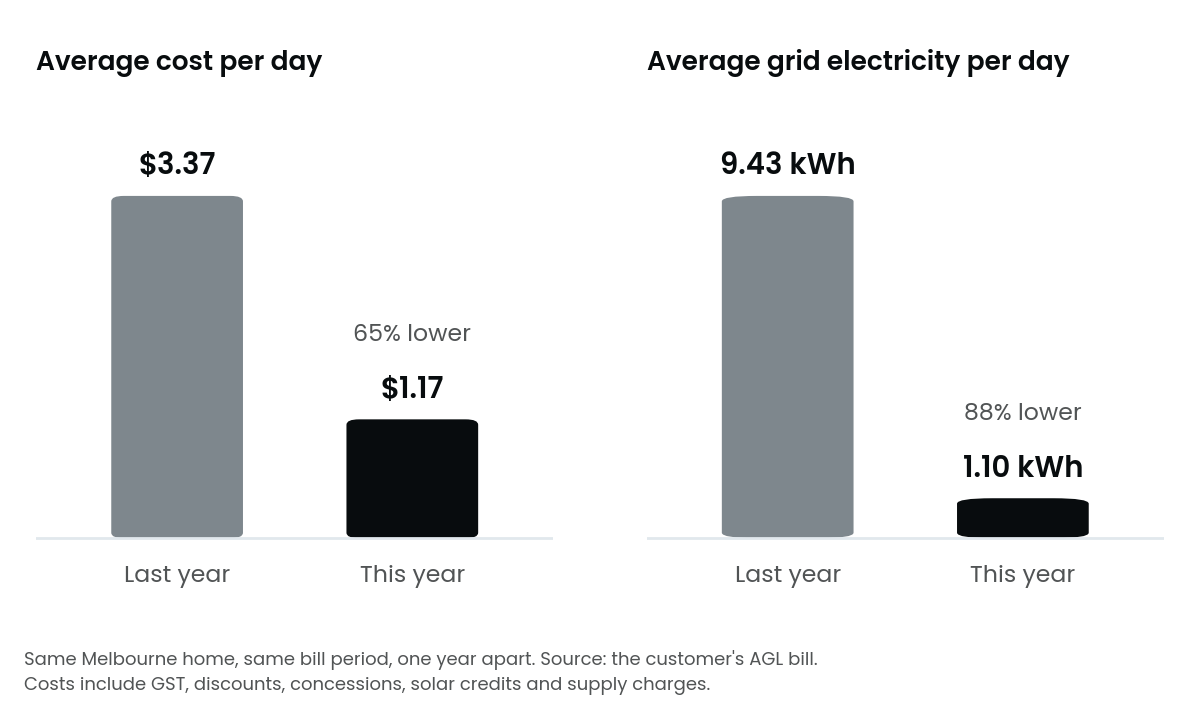
A Melbourne customer's AGL bill went from $3.37 a day to $1.17 a day a year after solar and a battery. Grid use fell 88% and the bill fell 65%. The gap between the two is the daily supply charge.
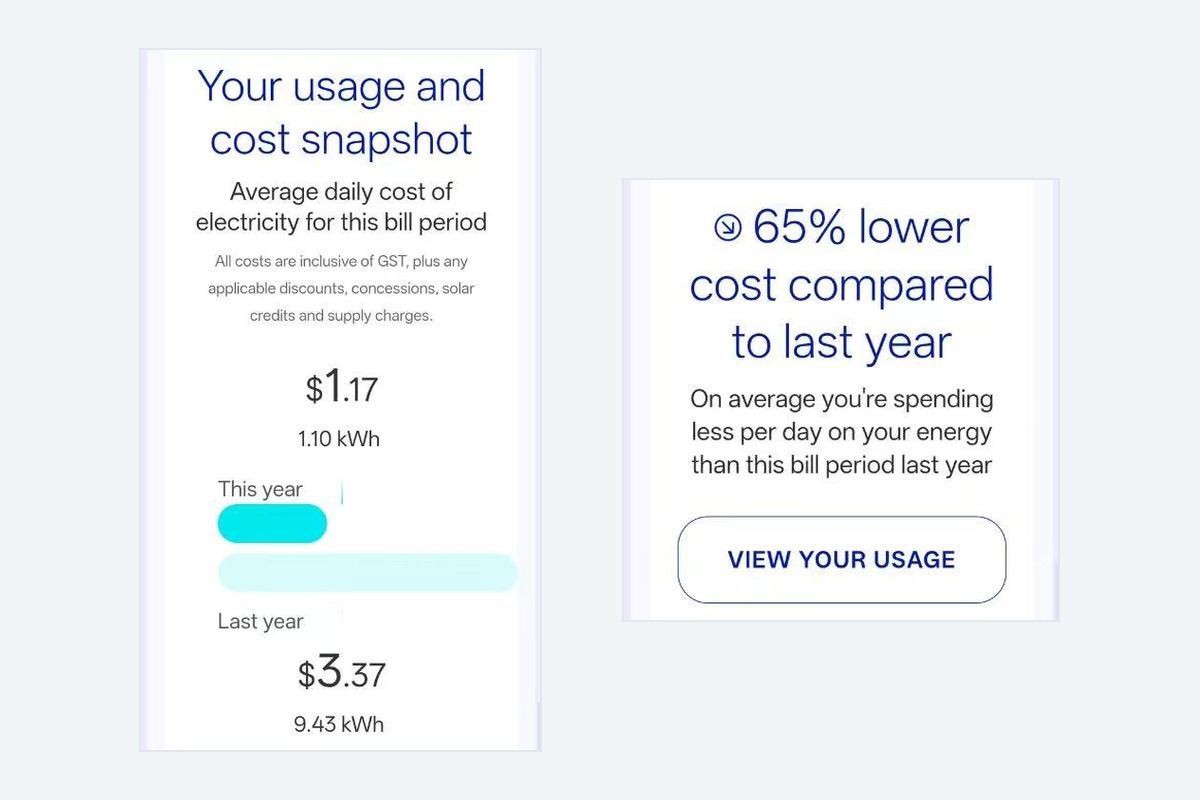
One of our Melbourne customers sent us their latest AGL bill a year after their solar panels and battery went in. The usage and cost snapshot on page one says it plainly: $1.17 a day this bill period, against $3.37 a day for the same bill period last year. AGL’s own summary line reads “65% lower cost compared to last year”.
That is a good result, and it is worth reading closely, because the two numbers under the dollar figures tell a more useful story. The household’s electricity from the grid fell from 9.43 kWh a day to 1.10 kWh a day, a drop of 88%. The bill fell 65%. The gap between those two percentages is the daily supply charge, and once a battery is doing its job, that fixed charge becomes most of what you pay.
This article walks through the bill, explains why it did not reach zero, shows what the supply charge costs across Victoria in 2026-27, and sets out what that means when you choose a battery and an electricity plan. One household is not a prediction for yours, and we say where the differences come from.
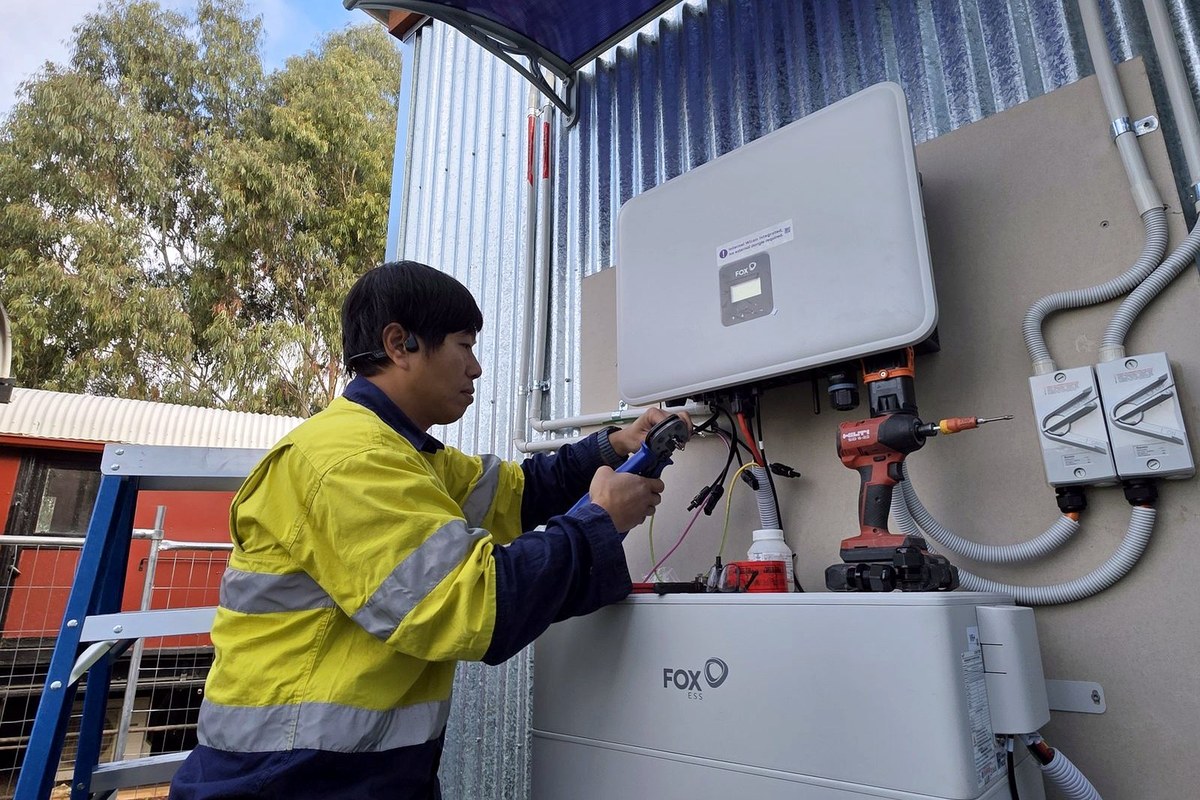
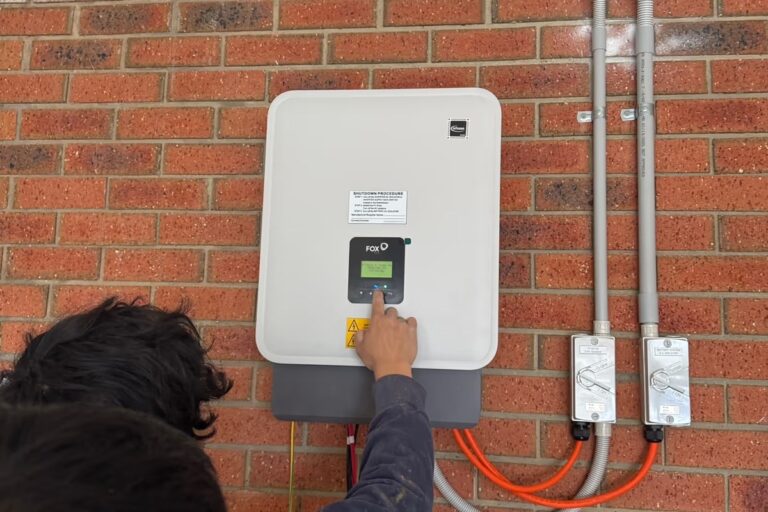
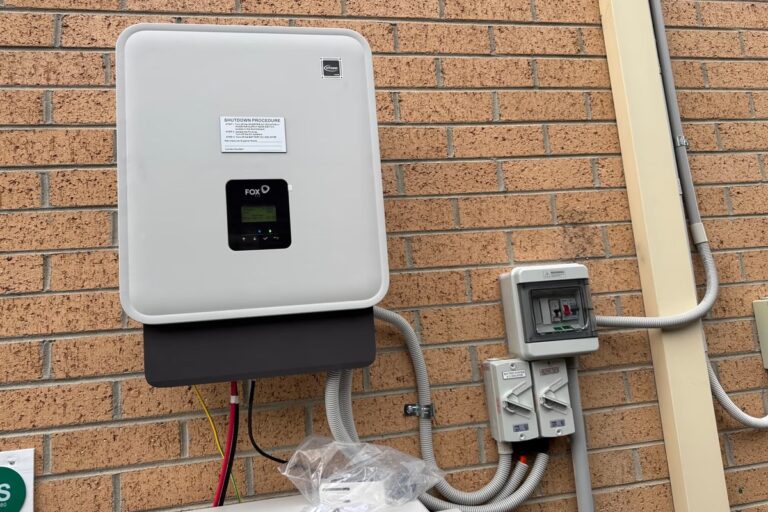
An E3 installer commissioning a Fox ESS inverter and battery. The bill in this article is from a different customer’s home.
The bill: what changed in one year
Here is the snapshot as AGL printed it. No personal details are shown.
The usage and cost snapshot from the customer’s AGL bill. AGL notes that the costs include GST, discounts, concessions, solar credits and supply charges.
Laid out as a table, with the change worked out from AGL’s figures:
Same bill period last year
This bill period
Change
Average cost per day
$3.37
$1.17
$2.20 a day less, 65% lower
Average grid electricity per day
9.43 kWh
1.10 kWh
8.33 kWh a day less, 88% lower
Comparing the same bill period a year apart matters. It takes most of the season out of the comparison: the same months of the year, with similar daylight hours. It does not remove everything. The weather is never identical, the household’s own use can change, and tariffs move every 1 July.
The household’s grid use fell further than its bill. The difference is the fixed daily supply charge.
Why grid use fell 88% but the bill fell 65%
An electricity bill has two main parts. The usage charge is what you pay for each kilowatt hour you take from the grid. The daily supply charge is a fixed amount you pay for every day you are connected, whether you use 30 kWh that day or none at all.
Solar and a battery attack the first part. During the day the panels run the home, and the battery stores the surplus so the evening and overnight hours can run on stored solar instead of grid power. That is how this home went from 9.43 kWh a day from the grid to 1.10 kWh. The battery has no effect on the second part. You pay the supply charge as long as the home stays connected to the grid.
The arithmetic shows how little of the $1.17 is usage now. At the regulated 2026-27 Victorian Default Offer usage rates, 1.10 kWh costs between 29 and 35 cents a day, depending on the network zone. The rest of the $1.17 is the daily supply charge, less whatever solar credits the bill applied. Before the battery, usage was the bigger number. After the battery, the fixed charge is.
What is the daily supply charge in Victoria in 2026-27?
The daily supply charge is a fixed charge, in dollars per day, that covers the cost of keeping your home connected to the poles and wires. It is set by your retailer, and it varies with your distribution zone, the company that owns the network in your area. In Victoria the Essential Services Commission sets the Victorian Default Offer, a regulated benchmark price. For 1 July 2026 to 30 June 2027, the default offer’s domestic flat tariff has a daily supply charge between $1.19 and $1.38 including GST, which is between about $435 and $504 a year before you use a single kilowatt hour. Market offers from retailers can be higher or lower than the default offer.
Distribution zone
Daily supply charge
Per year
Usage rate (flat tariff)
United Energy
$1.1912
about $435
27.35c per kWh
CitiPower
$1.2114
about $442
25.96c per kWh
Jemena
$1.2713
about $464
27.47c per kWh
AusNet Services
$1.2824
about $468
31.98c per kWh
Powercor
$1.3805
about $504
28.22c per kWh
Source: Essential Services Commission, Victorian Default Offer, domestic flat tariffs from 1 July 2026 to 30 June 2027, including GST. Yearly figures are our arithmetic over 365 days.
Your distributor is named on your bill, usually in the section about faults and emergencies. You cannot choose your zone; it is set by where you live. What you can choose is the retailer and the plan.
After a battery, compare plans on the supply charge first
This is the practical lesson from the bill, and the one most battery owners miss. The plan that was cheapest for you before the battery may not be the cheapest after it.
Before the battery, this household took 9.43 kWh a day from the grid. A plan with a usage rate 5 cents per kWh lower would have saved about $172 a year. After the battery, at 1.10 kWh a day, the same 5 cent difference is worth about $20 a year. A supply charge 20 cents a day lower is worth $73 a year whatever you use. These are illustrative figures from simple arithmetic, not an estimate for any particular plan, but they show where the weight has moved.
When you compare plans after installing a battery, check these in order:
The daily supply charge. Once grid use is small, this is the largest line on the bill.
The feed-in tariff. Victoria has had no regulated minimum feed-in tariff since 1 July 2025, so retailers set their own, and the only floor is zero. Our guide to solar feed-in tariffs in Victoria covers what exports are worth now and why using your solar at home usually beats selling it.
The tariff type and its windows. On a time-of-use tariff, the hours when the grid is cheapest matter to how the battery should charge. From 1 October 2026, most Victorian retailers also offer the Midday Power Saver, an opt-in plan with free electricity from 11am to 2pm, which changes the maths for some battery homes.
The usage rate. It still counts, but less than it did.
The Victorian Government’s Victorian Energy Compare site lets you enter your own usage and see every plan available at your address, including each plan’s supply charge.
Why the same battery gives different households different bills
We share this bill because it is real, and real results vary. Four things decide how close a home gets to this one:
How much the panels produce. Roof size, orientation, shading and the season all set how much solar is available to store. A small or shaded system may not fill a large battery on a cloudy week.
When the household uses power. Homes that use most of their electricity after sunset get the most from a battery. A home that already runs most loads in the middle of the day has less to shift.
Battery size against the evening load. If the battery runs flat at 2am, the rest of the night comes from the grid. If it is far larger than the evening load, part of it sits unused.
The plan. The supply charge, feed-in tariff and tariff windows set the dollar value of every kilowatt hour the battery moves.
This household still took 1.10 kWh a day from the grid. That is common even with a well-sized system: a run of cloudy days, a heavy appliance in the early morning before the panels produce much, or a minimum charge the battery is set to keep in reserve all add a little. The useful test is whether the system matches how your home uses power.
Start with your bill, not the battery spec
This is why we ask for a recent electricity bill before we recommend a battery size. The bill tells us how much you use each day, how much of it lands in the evening, what tariff you are on and what you pay to be connected. Those numbers decide the right size more than any brochure figure.
A bill check answers questions like these:
How many kWh a day do you take from the grid now, and what share of it is after dark?
Is your solar system large enough to charge a battery, or does it need to grow first?
What is your daily supply charge, and is your current plan still the right one once a battery is in?
Which battery size covers your evening use without paying for capacity you will not use?
We have two offers running this month. Neither one is the system in the bill above. Both start with the same bill check.
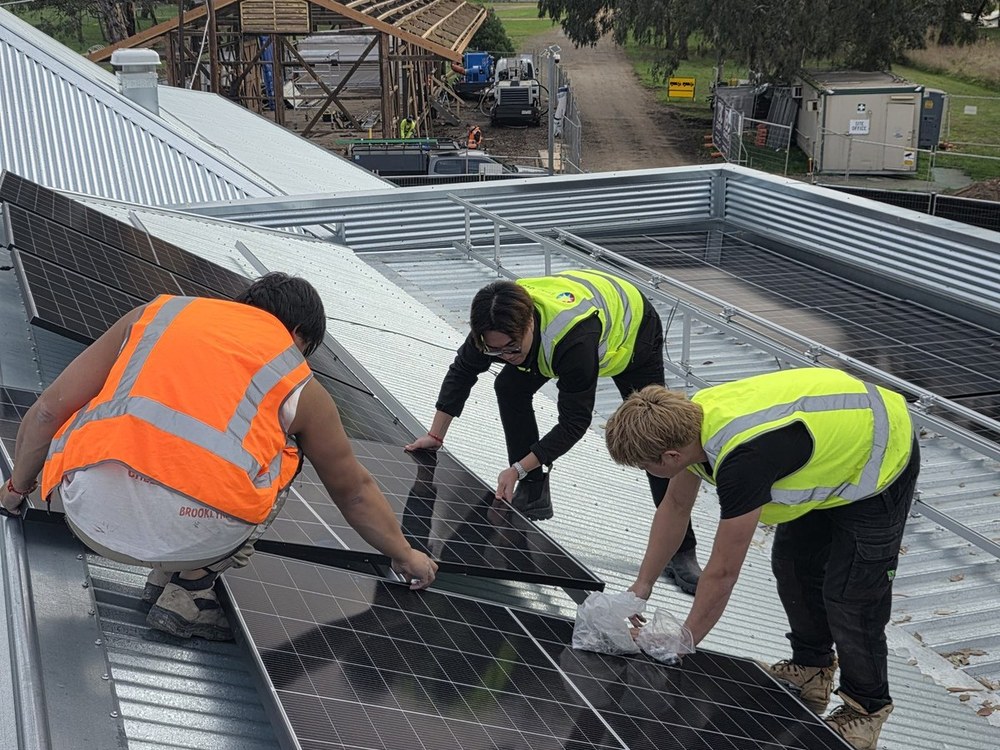
Our crew laying panels on a roof in Victoria.
No solar yet: SOFAR 6.6 kW solar and a 30 kWh battery, $4,099 after rebates for eligible homes. The price applies after the Solar Victoria solar panel rebate and federal STC discounts. Solar Victoria’s conditions include owning and living in the home, a combined taxable income for all owners under $150,000 a year, a property valued under $3 million, and no solar panel system installed at the address in the last 10 years. We check eligibility before we quote.
Already have solar: Fox ESS CQ7 42 kWh battery with a 10 kW hybrid inverter, installed from $6,999. The price covers the battery, the inverter and standard installation. If your panels are already on the roof, our guide to adding a battery to existing solar explains what we check first.
For both packages, a switchboard upgrade, meter or network requirements, and where the battery can safely go can change the price. You get a written quote with the final figure before anything is booked. For how the federal battery discount and Victorian rebates work, see our Victorian battery rebate guide.
Frequently asked questions
Why isn’t my electricity bill zero with solar and a battery?
Because of the daily supply charge. Solar and a battery cut the electricity you buy from the grid, but you still pay a fixed daily charge for being connected. Under the 2026-27 Victorian Default Offer that charge is between $1.19 and $1.38 a day including GST, depending on your distribution zone. Most battery homes also take a little from the grid on cloudy days or early mornings.
What is the daily supply charge in Victoria in 2026-27?
On the Victorian Default Offer domestic flat tariff, from 1 July 2026 to 30 June 2027, it is $1.1912 a day in the United Energy zone, $1.2114 for CitiPower, $1.2713 for Jemena, $1.2824 for AusNet Services and $1.3805 for Powercor, including GST. Retailers’ market offers can be higher or lower. Your own supply charge is printed on your bill.
Does a home battery reduce the daily supply charge?
No. The supply charge is fixed per day by your retailer and does not depend on how much you use. A battery lowers the usage part of the bill. To lower the supply charge you need a plan with a lower one, which you can compare on Victorian Energy Compare.
How much can solar and a battery cut my electricity bill?
It depends on your solar output, when you use power, the battery size and your plan. The customer in this article went from $3.37 a day to $1.17 a day, 65% lower than the same bill period a year earlier, while grid use fell 88%. That is one household’s result, not a forecast. A bill check is the way to estimate yours.
Should I change my electricity plan after installing a battery?
It is worth checking. Once a battery covers most of your evening use, the daily supply charge and the feed-in tariff matter more than the usage rate. A plan chosen for a home using 9 kWh a day from the grid may not be the best one for a home using 1 kWh a day.
Want us to read your bill?
Send us your latest electricity bill. We will look at your daily grid use, how much of it falls in the evening, your tariff and your supply charge, and tell you what size battery fits, which of this month’s packages suits your home, and whether a battery stacks up at all. If it does not, we will say so.
A Melbourne E3 Energy customer’s AGL electricity bill, usage and cost snapshot: average daily cost and average daily usage for this bill period and the same bill period last year. Shared without personal details.
Essential Services Commission, Victorian Default Offer. Domestic flat tariff daily supply charges and usage rates by distribution zone, 1 July 2026 to 30 June 2027, including GST.
Essential Services Commission, Minimum feed-in tariff. No minimum feed-in tariffs from 1 July 2025; retailer rates cannot be below zero.
Victorian Government, Victorian Midday Power Saver. Opt-in plan with free electricity from 11am to 2pm from 1 October 2026.
Pages checked on 14 October 2026. The percentage changes, yearly supply charge figures and plan comparisons are E3 Energy calculations from the bill and the published default offer tariffs. They are not a savings estimate for any particular home. Package prices apply to eligible homes and are confirmed in a written quote.