Sigenergy vs Fox ESS: Which Home Battery Is Right for You? (2026)
We install both. A straight comparison of the Sigenergy SigenStor and the Fox ESS CQ7 for Melbourne homes, and how the 2026 rebate tapers change which capacity is good value.
Almost every home battery comparison you will read online was written by someone who sells one of the batteries in it. We install both Sigenergy and Fox ESS across Melbourne, so we have no reason to talk you out of either. What follows is the comparison we actually walk customers through: what each system is, where they genuinely differ, and how the 2026 federal rebate rules change which capacity is good value.
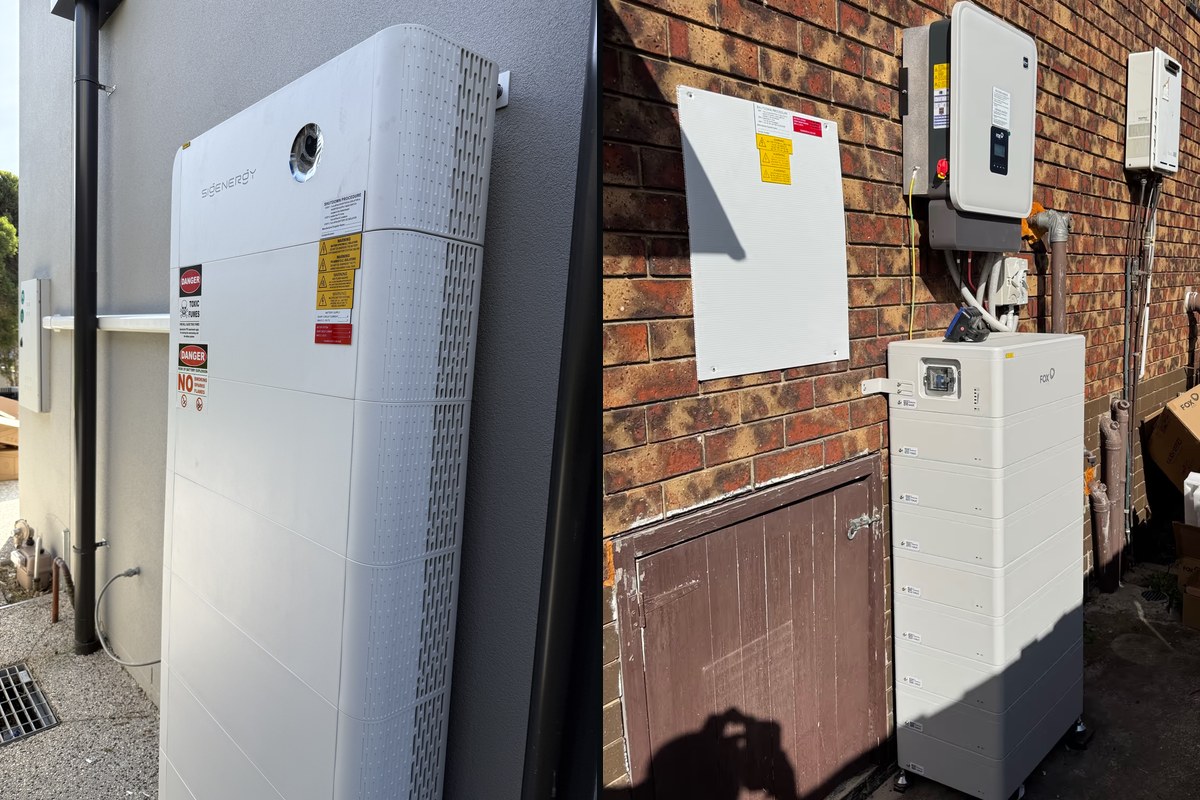
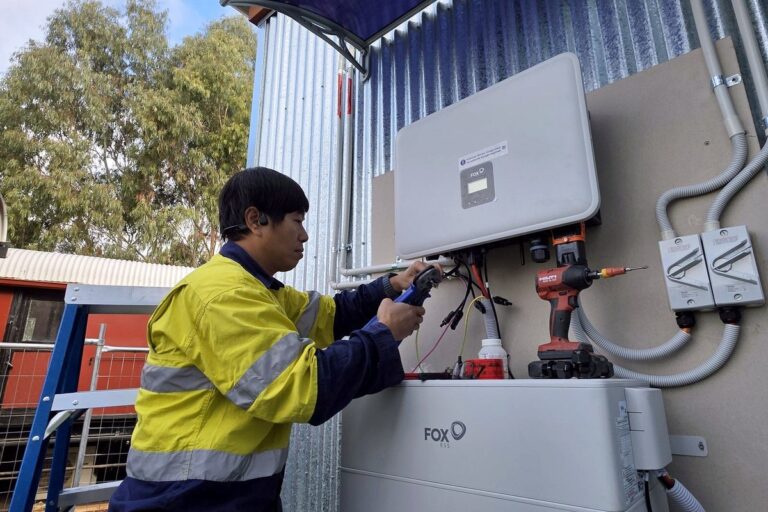
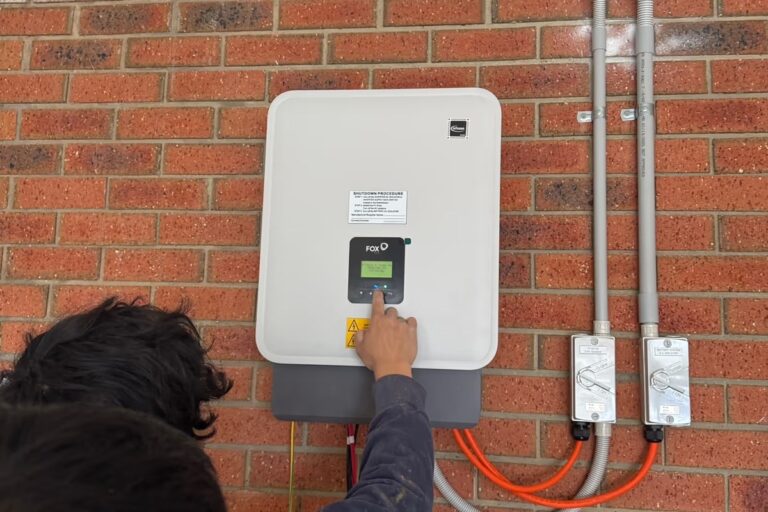
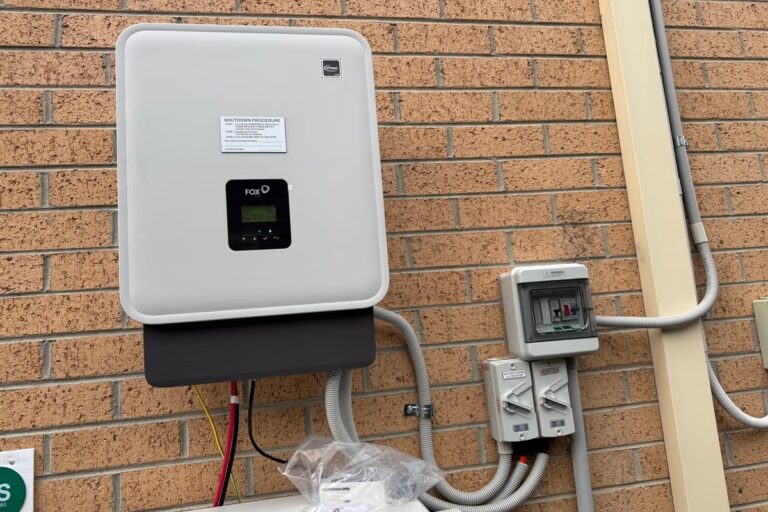
Both systems on real E3 Energy installations in Melbourne. Left: Sigenergy SigenStor. Right: a stacked Fox ESS battery with its inverter.
The short version
Fox ESS suits households that want storage sized to an evening peak, at the lowest cost per usable kilowatt-hour, on a system that stacks in small steps. Sigenergy suits households that want one integrated unit doing several jobs at once, particularly if an electric vehicle is in the picture, because DC EV charging is built into the same cabinet. Neither is the better battery in the abstract. The right one depends on your evening usage, whether you already have solar, and what else you want the system to do in the next five years.
What each system actually is
The two are built on different ideas, and that is the real difference. Everything else follows from it.
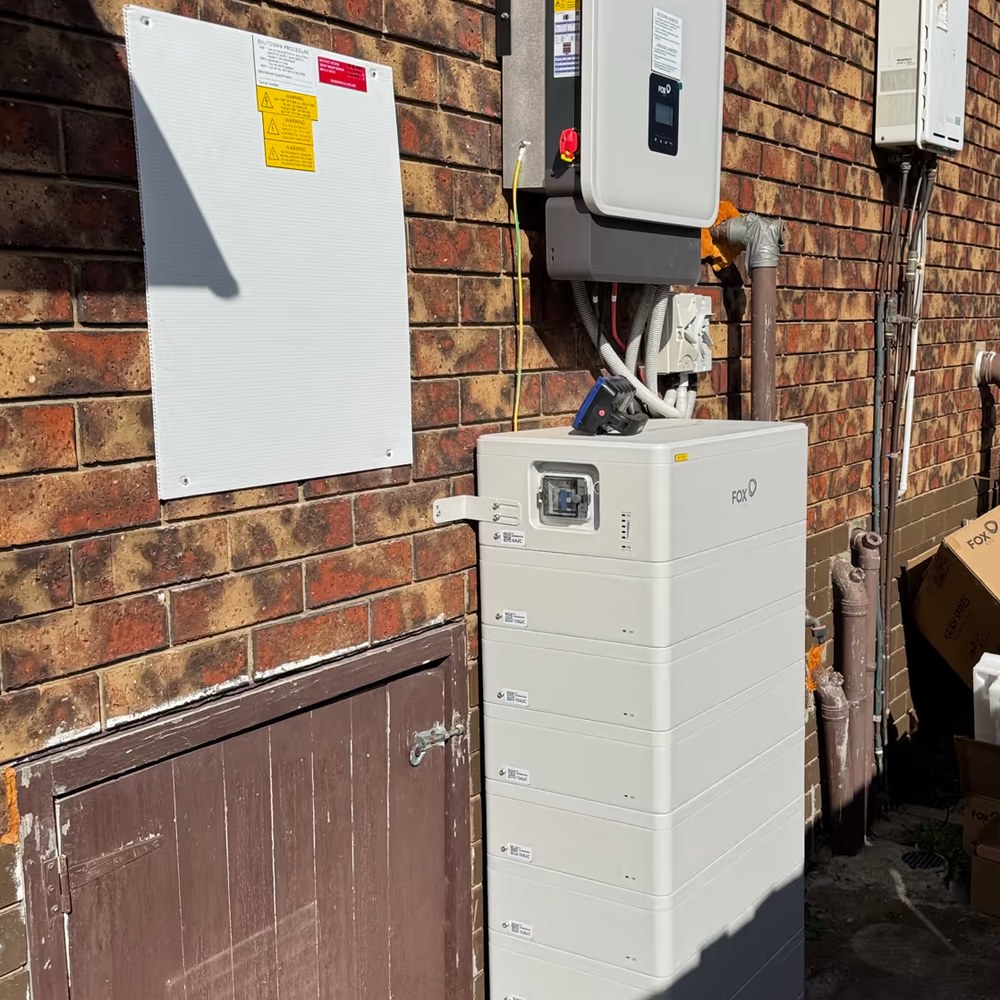
Fox ESS CQ7 is a high voltage stacked battery. You start with a base configuration and add modules to the tower as your needs grow. It pairs with a Fox inverter, and the battery, inverter and any backup gear are separate components on the wall. Chemistry is LFP (lithium iron phosphate), the tower scales in 7.02 kWh steps, and the datasheet lists a maximum of 14 modules in series.
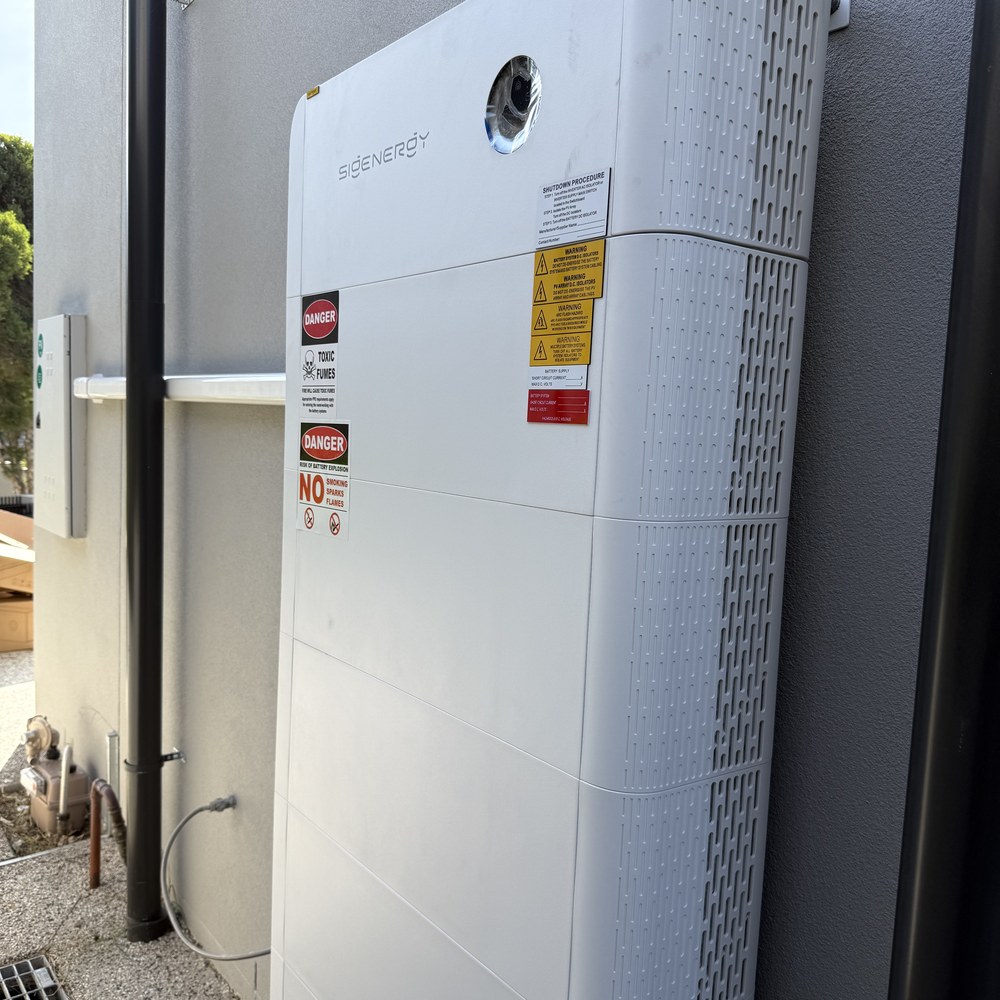
Sigenergy SigenStor is what Sigenergy calls a 5-in-one system. One product line combines the solar inverter, the battery pack, the battery PCS, an EV DC charger and the energy management system. You add battery modules under a single controller rather than bolting separate boxes to the wall.
A Fox ESS install: the battery tower stacks in modules, with the inverter and isolators as separate components.
Side by side
These figures come from the manufacturers’ own published specifications. They are the starting point of a comparison, not the end of one, because the numbers that decide your bill are your usage and your quote.
Fox ESS CQ7
Sigenergy SigenStor
Design
Stacked high voltage battery, separate inverter
Integrated unit: inverter, battery, PCS, EV DC charger, EMS
Chemistry
LFP (LiFePO4)
LFP (LiFePO4)
Capacity steps
14.04 kWh at the base configuration, in 7.02 kWh modules, to 98.28 kWh
Battery modules of 6.02 kWh or 9.04 kWh total energy capacity, one to six modules per controller
Stated depth of discharge
90%
100%, footnoted as referring to usable energy capacity
Inverter output
Paired Fox inverter, sized to the system
3 kW to 12 kW single phase, 5 kW to 30 kW three phase
EV charging
Via a separate EV charger
DC charging module in the same system, 12.5 kW or 25 kW, CCS2
Ingress protection
IP65
IP66
Efficiency figure published
Battery pack round trip efficiency above 95%
Inverter maximum efficiency 97.6% to 98.0% single phase
Note that the last two rows measure different things. Fox publishes a battery round trip figure and Sigenergy publishes an inverter conversion figure, so they cannot be subtracted from one another. This is common in battery marketing and it is worth checking what any efficiency claim on a quote is actually measuring.
The number most quotes get wrong
Every battery has two capacity numbers. Nominal capacity is the rated figure printed on the label. Usable capacity is what your home can actually draw on after sunset, and it is lower, because no battery is designed to be run flat.
The two brands publish this differently. Fox ESS lists a 90% depth of discharge on the CQ7 datasheet. Sigenergy states 100% depth of discharge with a footnote that the figure refers to usable energy capacity. Those are not measured the same way, so the only number worth comparing across brands is the usable kilowatt-hours written on your quote.
This matters for more than bragging rights. The federal rebate is calculated on usable capacity, so the gap between the two numbers is also a gap in what you are paid. If a quote only shows you the nominal figure, ask for the usable one before you compare it against anything.
How the 2026 rebate rules change the maths
Since 1 May 2026 the Cheaper Home Batteries Program has paid on a tapering scale. The support is delivered as small-scale technology certificates (STCs), and the STC Factor that sets how many certificates a system creates per kilowatt-hour is applied at three levels: 100% for the first 14 kWh of usable capacity, 60% for every kilowatt-hour above 14 and up to 28 kWh, and 15% from 28 up to 50 kWh. Above 50 kWh, nothing.
The practical consequence is that support per kilowatt-hour falls as the system gets larger. Using the STC Factor of 6.8 that applies from May to December 2026, the certificates created at common sizes work out as follows.
Usable capacity
STCs created
STCs per kWh
10 kWh
68.0
6.80
14 kWh
95.2
6.80
20 kWh
119.7
5.98
28 kWh
152.3
5.44
50 kWh
174.8
3.50
Calculated from the STC Factor and capacity tapers published by DCCEEW. The dollar value of a certificate depends on the STC market price on the day your battery is installed, which is why advertised rebate figures vary between installers quoting the same battery. DCCEEW describes the overall support as a discount of around 30% on the upfront cost. Our Victorian battery rebate guide breaks the dollar side down.
Two things follow for a brand comparison. First, a system sized near the top of the 100% band earns the most support per kilowatt-hour, whichever brand it is, so the modularity of both product lines is worth using deliberately rather than rounding up to the next tidy number. Second, the STC Factor drops from 6.8 to 5.7 on 1 January 2027, which is about 16% less support per kilowatt-hour for the same battery, and it steps down every six months after that until the scheme ends in 2030. The discount is set by the factor on the date your battery is installed, not the date you sign.
A SigenStor install: one cabinet carrying the inverter, battery and energy management, with DC EV charging available in the same system.
Which one suits which household
In practice the decision usually comes down to one of four situations.
You have solar already and want to stop exporting cheaply. A stacked Fox ESS system is generally the most direct way to add storage sized to your evening peak without rebuilding what is already on the roof. See how to size it to your bills.
You drive an EV, or you will within a couple of years. This is where SigenStor earns its price. DC charging from the battery and panels sits inside the same system, rather than as another box with its own controller and its own app.
Backup during outages is the main reason you are buying. Both can do it, and neither does it automatically. Backup is designed circuit by circuit, so what decides this is the scope written into your quote rather than the badge on the cabinet.
You want the lowest cost per usable kilowatt-hour. Fox ESS is usually the answer, which is why it is the system in our advertised package.
What we install, and what it costs
Our standard residential package is the Fox ESS CQ7 at 14.04 kWh with an 8 kW inverter, from $5,299 installed for eligible existing-solar homes in Melbourne. Final price depends on your site, switchboard, meter, network requirements and backup scope, and you get that in a written quote before any work starts. Sigenergy is quoted on assessment, because the configuration depends on how many modules and which charging module you need.
E3 Energy is based in Mitcham, we are a Solar Victoria Authorised Retailer and a New Energy Tech Consumer Code (NETCC) Approved Seller, and we install both product lines. Under the federal program the battery has to be on the Clean Energy Council approved list and the installer has to be accredited by Solar Accreditation Australia, which applies to whoever you buy from.
Frequently asked questions
Is Sigenergy better than Fox ESS?
Neither is better in general. Sigenergy integrates the inverter, battery, energy management and DC EV charging into one system, which suits households charging an electric vehicle. Fox ESS is a stacked battery paired with a separate inverter and usually gives a lower cost per usable kilowatt-hour. The right choice depends on your evening usage, your existing solar and whether EV charging matters to you.
Which battery gets the bigger rebate?
Neither, as a brand. The federal Cheaper Home Batteries Program pays per kilowatt-hour of usable capacity, not per brand, and the rate tapers above 14 kWh and again above 28 kWh. Two systems of the same usable capacity attract the same support regardless of badge, so the rebate question is really a sizing question.
How much is a Sigenergy battery in Melbourne?
It depends on how many battery modules you need and whether you include the DC EV charging module, so we quote it after an assessment rather than advertising a package price. Our advertised Fox ESS CQ7 configuration starts from $5,299 installed for eligible existing-solar homes, with the final figure confirmed in writing.
Can I add either battery to solar I already have?
In most cases, yes. Both can be retrofitted to an existing solar system, and the checks are the same either way: your current inverter, your meter, your switchboard and your network requirements. We confirm compatibility before quoting.
What about the Tesla Powerwall 3?
We do not install it, so we will not pretend to review it. If you are cross-shopping, compare the three things that actually decide the outcome: usable capacity in kilowatt-hours, what backup circuits are included in writing, and the warranty terms covering years, throughput and capacity retention. Those are comparable across every brand.
How long is the warranty on each?
Fox ESS publishes a battery warranty policy for Australia and New Zealand covering the CQ7 series, with a capacity retention threshold and an energy throughput limit alongside the term in years. Sigenergy publishes separate Australian and New Zealand warranty documents for the SigenStor, the inverter and the EV AC charger. Because an integrated system can be covered by more than one document, ask which document applies to each part of the system you are quoted.
Do you sell one harder than the other?
We install both, and we size to your usage data first and recommend a product second. If your evening usage and solar surplus point to a smaller system, we will tell you that, even where a larger one would be a bigger sale.
Sources
Fox ESS, CQ7 High Voltage Storage Battery datasheet, version 1.1: capacity steps, 90% depth of discharge, round trip efficiency, IP65, module scalability.
Fox ESS, Battery Warranty Policy for Australia and New Zealand, version 2.7: CQ7 series warranty structure.
Sigenergy, SigenStor product and specifications pages: 5-in-one configuration, LFP modules of 6.02 kWh and 9.04 kWh, one to six modules per controller, inverter output ranges, EV DC charging module, IP66, depth of discharge statement.
Department of Climate Change, Energy, the Environment and Water (DCCEEW), Cheaper Home Batteries Program, updated 9 June 2026: STC Factor table (6.8 for May to December 2026, 5.7 for January to June 2027), capacity tapers of 100% to 14 kWh, 60% to 28 kWh and 15% to 50 kWh, eligible range of 5 kWh to 100 kWh, and the discount being set by the factor on the installation date.
E3 Energy accreditations: Solar Victoria Authorised Retailer and NETCC Approved Seller (registered entity E Cubic Energy).