Fox ESS CQ7 Price: What the Battery Rebate Takes Off, Model by Model
The federal battery discount on a Fox ESS CQ7 is worth $3,400 to $6,960 depending on how many modules you stack, and the rate drops on 1 January 2027. Here is the calculation, model by model.
Nobody can hand you one honest number for a Fox ESS CQ7 installed on your house. Too much of the price sits in things a webpage cannot see: how far your switchboard is from the wall you had in mind, whether you are single or three-phase, what your meter needs, whether the board has room for another breaker.
But one part of the price is fixed by regulation, and you can work it out yourself before you talk to anyone. That is the federal battery discount, and for a CQ7 it is worth between $3,400 and $6,960 depending on how many modules you stack.
It is also the part with a date on it. The rate that applies right now runs until 31 December 2026. On 1 January it steps down, and then again every six months until the scheme finishes in 2030.
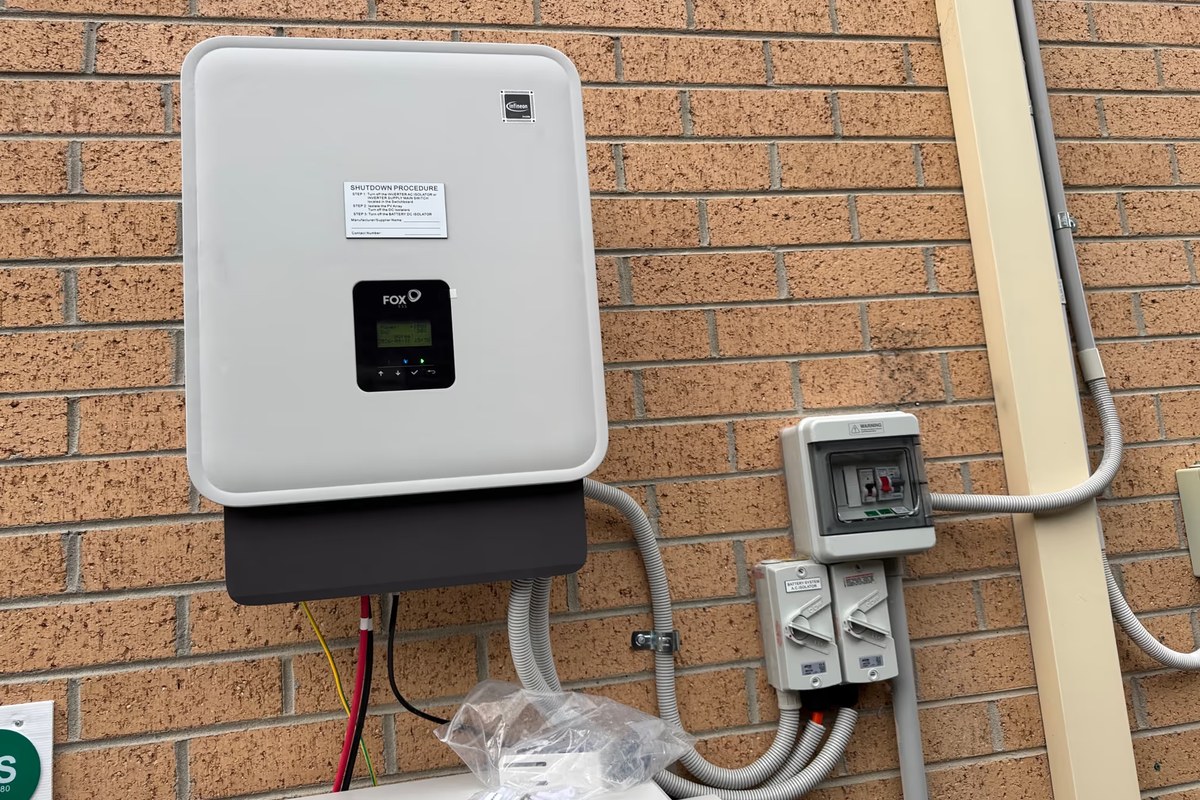
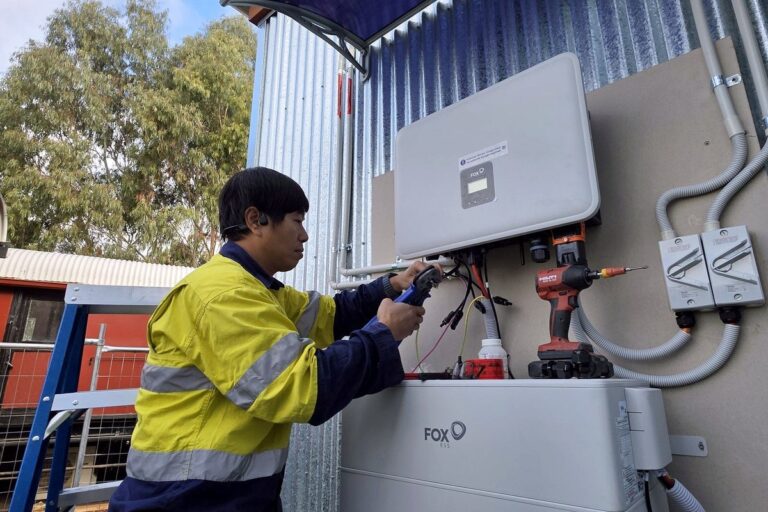
A Fox install on one of our Melbourne jobs. The discount is calculated on the usable capacity of the battery, so the number of modules stacked below this inverter is what decides it.
The discount is a formula, not a negotiation
The Cheaper Home Batteries Program does not pay you a grant. It lets your battery create small-scale technology certificates (STCs), and you assign the right to create them to your installer in exchange for an upfront discount. Three inputs decide the number:
Usable capacity of the battery system, in kWh.
The STC Factor, which is certificates per kWh and is set by the installation date. From 1 May to 31 December 2026 it is 6.8.
The certificate price. The STC Clearing House price is fixed in regulation at $40 per certificate, excluding GST.
Since 1 May 2026 the factor also tapers by size, so not every kWh earns the same:
The first 14 kWh of usable capacity: factor at 100%, which is 6.8 certificates per kWh, or $272 per kWh.
Above 14 and up to 28 kWh: factor at 60%, or $163.20 per kWh.
Above 28 and up to 50 kWh: factor at 15%, or $40.80 per kWh.
Certificates are rounded down to a whole number, and only the first 50 kWh of usable capacity earns anything at all. Those rules come from the Department of Climate Change, Energy, the Environment and Water, which sets the policy, and the Clean Energy Regulator, which runs the scheme.
What each CQ7 is worth today, and in January
A CQ7 module holds 7.02 kWh nominal and the system runs to 90% depth of discharge, so a four-module CQ7-L4 is 28.08 kWh nominal and 25.3 kWh usable. Run that through the formula and the discount looks like this.
Model
Modules
Usable
Certificates now
Discount now
From 1 Jan 2027
You lose
CQ7-L2
2
12.6 kWh
85
$3,400
$2,840
$560
CQ7-L3
3
19.0 kWh
115
$4,600
$3,840
$760
CQ7-L4
4
25.3 kWh
141
$5,640
$4,720
$920
CQ7-L5
5
31.6 kWh
155
$6,200
$5,200
$1,000
CQ7-L6
6
37.9 kWh
162
$6,480
$5,440
$1,040
CQ7-L7
7
44.2 kWh
168
$6,720
$5,640
$1,080
CQ7-L8
8
50.5 kWh
174
$6,960
$5,840
$1,120
Two notes on reading that table honestly. The $40 is the Clearing House price set in regulation, so treat these as the ceiling: certificates traded on the open market can settle a little under it, and some retailers deduct an administration fee, which they are required to disclose against the price of the system. And the certificate count follows the usable capacity recorded for the product, so ask for the exact figure your installer is claiming rather than assuming the datasheet arithmetic above.
A CQ7-L8 is the last model where extra capacity still earns anything worth counting. Its usable capacity is 50.5 kWh, and certificates stop at 50, so half a kilowatt hour of it earns nothing.
The date that matters is the installation date
This is the part people get wrong, and it costs real money in December.
The department’s wording is specific: the discount you are entitled to is determined by the STC Factor on the date the battery is installed. Not the date you sign. Not the date you pay a deposit. Not the date the paperwork goes in.
So a quote accepted in mid-December with an install booked for the second week of January is a January install at the January rate. On a CQ7-L4 that is $920 off the table. In practice, installer calendars in Victoria fill through November and December, and grid connection paperwork does not speed up for Christmas. If you want the 2026 rate, the booking, not the decision, is what has to happen this side of the break.
Why the biggest stack is not the best value per kWh
The taper has a consequence that almost nobody spells out: each additional module earns less discount than the one before it, and the drop is steep.
Step up
Extra usable
Extra certificates
Extra discount
Per extra kWh
L2 to L3
+6.4 kWh
+30
+$1,200
$188
L3 to L4
+6.3 kWh
+26
+$1,040
$165
L4 to L5
+6.3 kWh
+14
+$560
$89
L5 to L6
+6.3 kWh
+7
+$280
$44
L6 to L7
+6.3 kWh
+6
+$240
$38
The hardware cost of each module barely changes. The discount on it falls by a factor of five between the third module and the sixth. That is the arithmetic behind the advice we give on the phone anyway: size the battery to your evening load and your solar export, then let the discount fall where it falls. Buying two extra modules to chase a bigger rebate number is backwards, because those are the modules the scheme has deliberately stopped paying for. If you have not worked out your number yet, start with what size battery your house actually needs rather than a brochure.
The first 14 kWh carries the discount. Everything above it is a decision about your house, not about the rebate.
What the discount does not touch
The rebate comes off the system. It does not change what sits underneath it, and this is where quotes diverge from each other:
Switchboard work. Older Melbourne boards often need an upgrade or at minimum room made for new breakers.
Single phase versus three phase. Three-phase sites need matching hardware, and it is not a small line item.
Distance and cable run. The wall you want the battery on and the board it has to reach are sometimes at opposite ends of the house.
Metering and grid connection. Your distributor’s requirements, not your installer’s choice.
Retrofit versus new solar. Adding storage to an existing array is a different job to a fresh install. We wrote that one up separately in adding a battery to existing solar.
For the ranges those variables produce on real Melbourne jobs, the numbers are in our home battery cost guide. For the physical side of a CQ7 specifically, including whether the wall you have in mind is legal, see CQ7 dimensions and placement.
Victoria on top
The federal program is national and is designed to sit alongside state schemes. Whether a Victorian incentive applies on top of it depends on the rules Solar Victoria sets, and those change independently of the federal rate. We keep the current position in the Victorian home battery rebate guide, which is the page to check before you assume two discounts stack.
Two conditions apply to the federal discount regardless of state: the battery has to be connected to solar PV, new or existing, and the product has to be Clean Energy Council accredited and installed by an installer accredited with Solar Accreditation Australia. Both are worth checking on a quote rather than taking on trust.
Frequently asked questions
How much is the Fox ESS CQ7 rebate right now?
For installations completed between 1 May and 31 December 2026, the STC Factor is 6.8 certificates per kWh of usable capacity, with the factor applied at 100% on the first 14 kWh, 60% between 14 and 28 kWh, and 15% between 28 and 50 kWh. At the Clearing House price of $40 per certificate excluding GST, that is $3,400 on a CQ7-L2, $4,600 on a CQ7-L3, $5,640 on a CQ7-L4, $6,200 on a CQ7-L5 and $6,480 on a CQ7-L6. Certificates are rounded down to whole numbers. Source: DCCEEW, Cheaper Home Batteries Program, page updated 9 June 2026.
What happens to the battery rebate on 1 January 2027?
The STC Factor drops from 6.8 to 5.7 for installations from 1 January 2027, then to 5.2 from 1 July 2027, 4.6 from 1 January 2028, 4.1 from 1 July 2028, 3.6 from 1 January 2029, 3.1 from 1 July 2029, 2.6 from 1 January 2030 and 2.1 from 1 July 2030, when the scheme ends. On a CQ7-L4 the January step alone is a difference of $920. The schedule is published by DCCEEW and was set by amendments to the Renewable Energy (Electricity) Regulations 2001 finalised on 5 February 2026. Source: DCCEEW, Cheaper Home Batteries Program, Table 1, page updated 9 June 2026.
Does signing a contract before 31 December lock in the current rate?
No. DCCEEW states that the discount you are entitled to is determined by the STC Factor on the date the battery is installed. A contract signed in December for a January installation attracts the January rate. If the current rate matters to your budget, the installation date is what needs to be secured, not the paperwork date. Source: DCCEEW, Cheaper Home Batteries Program, page updated 9 June 2026.
Why does a bigger CQ7 not get proportionally more rebate?
Because the STC Factor tapers with capacity. The first 14 kWh of usable capacity is credited at the full factor, capacity between 14 and 28 kWh at 60% of it, and capacity between 28 and 50 kWh at 15%. Nothing above 50 kWh of usable capacity earns certificates. In CQ7 terms, the step from a three-module to a four-module system adds about $1,040 of discount, while the step from five modules to six adds about $280 for almost the same amount of extra storage. Source: DCCEEW, Small-scale technology certificates for batteries.
Do I have to apply for the rebate?
No. Consumers do not apply to DCCEEW or the Clean Energy Regulator. You either assign the right to create the certificates to your retailer or installer in exchange for an upfront discount, or you keep the right and create and sell the certificates yourself through a REC Registry account, in which case you receive the money when they sell rather than as a discount on the invoice. If you assign them, the installer must clearly display the discount against the price of the system. Source: DCCEEW, Cheaper Home Batteries Program.
Is the battery eligible if my solar is already installed?
Yes. The discount is available for batteries connected to new or existing solar PV systems, for systems from 5 kWh to 100 kWh of nominal capacity. Certificates are only created for the first 50 kWh of usable capacity. The product must be accredited by the Clean Energy Council and the installer accredited by Solar Accreditation Australia. Source: DCCEEW, Cheaper Home Batteries Program and Small-scale technology certificates for batteries.
Want the rest of the number
The discount above is the part we can publish. The rest depends on your board, your phase, your meter and the run from the wall to the switchboard, which is why we look at photos of the switchboard and the proposed wall before quoting rather than after.
Send us a recent bill and a photo of your switchboard and we will come back with the full installed figure, the exact certificate count we would claim, and the earliest install date we can actually hold for you this side of 31 December. Book a free assessment or call 1300 254 507.
Sources
Department of Climate Change, Energy, the Environment and Water, Cheaper Home Batteries Program, page updated 9 June 2026. STC Factor schedule to 2030, the 1 May 2026 taper by capacity, installation date determining entitlement, eligibility and the two ways to access the discount.
Department of Climate Change, Energy, the Environment and Water, Small-scale technology certificates (STCs) for batteries. The $40 Clearing House price set in regulation, the 5 kWh to 100 kWh eligibility range, the 50 kWh certificate cap and rounding down.
Renewable Energy (Electricity) Regulations 2001, as amended by F2026L00093, finalised 5 February 2026, commenced 1 May 2026.
Fox ESS CQ7 datasheet. 7.02 kWh per module, 14.04 kWh to 98.28 kWh nominal across CQ7-L2 to CQ7-L14, 90% depth of discharge.
All government pages checked on 16 September 2026. Discount figures are calculated from the published STC Factor and the regulated Clearing House price and are an estimate, not a quote. Program settings are reviewed at least annually and can change.